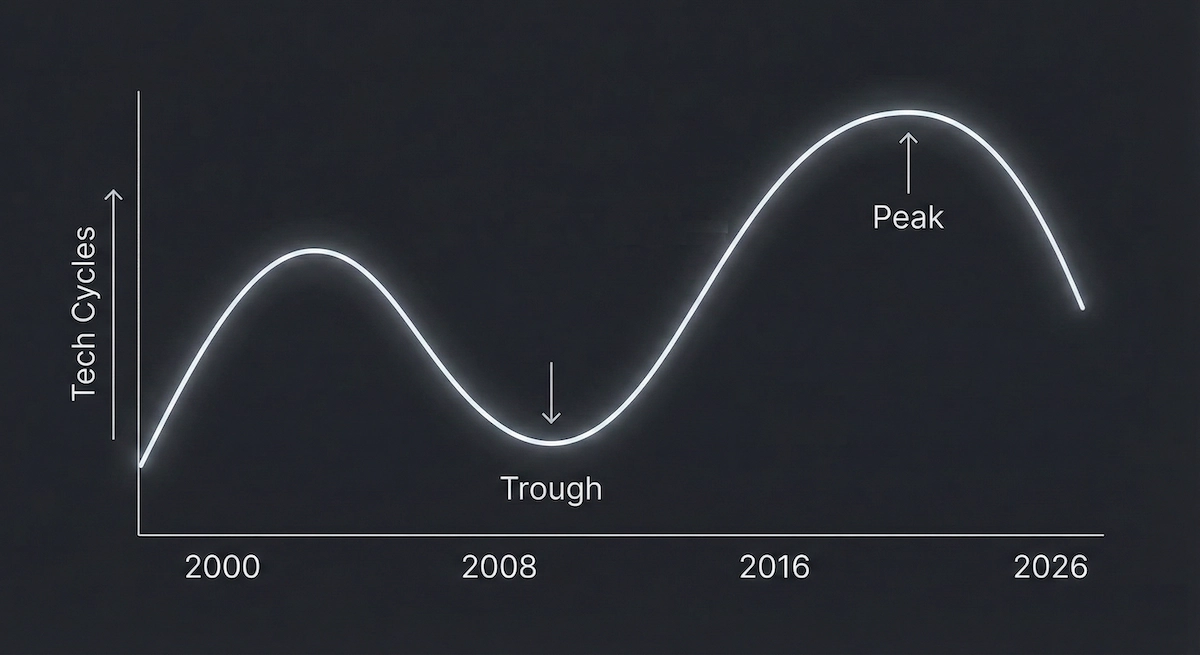
In 2008 I was a young 21 year old recent graduate in the midst of the global financial crisis. The cloud was emerging and a lot of engineers were worried about security and reliability of cloud services. Ray Dalio often says that ‘most of what happens in the world is just the same things happening over and over again.’ This is very true in the tech industry. During my career I went through three of these cycles and currently in the middle of my fourth cycle. In this article I want to share my experience with each of them.
The cycle
I start to recognise a pattern of 3 stages when a new technology emerges: 1: Wild West, 2: Armageddon, 3: adoption
Stage 1: The Wild West
A new technology emerges and everyone gets really excited about it. Developers fear for their jobs or the negative impact of the technology. Companies and investors are greedy and over leverage to capitalise on the new technology. The so called market prophets are coming out with big bold predictions about a new world.
Stage 2: Armageddon
The cycle hits a breaking point when the (technical and financial) debt accrued during the Wild West becomes unserviceable, leading to catastrophic “big accidents” like massive data breaches or systemic outages. Organisations face a harsh financial awakening as they realise the infinite scale they were promised has resulted in spiraling, uncontrollable costs and wasted capital. This is the depression of the tech cycle, where the industry is forced to stop expanding and start cleaning up the mess of the previous years and deliver on the big promises.
Stage 3: Adoption
The industry finally reaches a state of “Normal” by shedding the hype and retaining only the tools and workflows that deliver proven, measurable ROI. The “debt” is restructured into stable, governed architectures, and developers find a new balance where the technology assists rather than replaces their core expertise. This phase represents the true productivity plateau, where the once-revolutionary tech becomes a standard, boring commodity.
The cycles during my career
I “survived” 3 cycles during my career and I will share my experience with each of them.
The cloud cycle (2008)
In 2008 it was “Cloud First” mania where companies, desperate to appear modern, performed massive “lift-and-shift” migrations of legacy junk into the cloud without any cost-benefit analysis. During this period, investors poured billions into any SaaS startup that promised to “kill the data center,” often backing clones of existing software that simply moved the same bad processes to a new server. This era was so speculative that even legacy corporations began renaming their IT departments to “Cloud Centers of Excellence” purely to signal innovation to shareholders. This couldn’t end up well and Armageddon arrived when the first “bill shock” happened. Companies realised they were locked-in to expensive cloud services and the hidden costs of unoptimised cloud usage were far more expensive than owning hardware. Also, the lack of proper security configurations led to high-profile security leaks from poorly configured S3 buckets, open ports, and misconfigured IAM roles. Things started to settle down when organisations started to adopt a more pragmatic approach and have settled on a Hybrid Cloud model that treats cloud as a surgical tool for speed rather than a replacement for all infrastructure.
Crypto(2017)
I remember this cycle fondly. I was at a conference and everyone was talking about how banks would soon be obsolete and professing the end of SWIFT. However when I was talking to developers and trying out the technology myself I realised how limited and complex it was. This didn’t stop the investors from abandoning all traditional due diligence, funding anonymous founders based on ten-page “whitepapers” that promised to decentralise everything from bananas to healthcare. This land grab saw VCs competing to get into ICOs (Initial Coin Offerings) that had no working code, driven by a fear that missing the next Bitcoin was a career-ending mistake. For fun just look up the story of the Long Island Iced Tea corp. The fall was brutal and hit with a multi billion dollar collapse of FTX and Terra Luna. It exposed how much was funded on circular technical debt and pure outright fraud. I think things started to settle a bit more in 2024 when the focus shifted to more practical applications like DeFi and NFTs over get rich quick schemes.
No code / low code (2020)
I think this cycle has the most parallels with the AI hype. It all started with the myth told to executives that they could build applications without expensive developers by using visual builders. Investors, sensing a way to bypass the global developer shortage, backed dozens of no-code for enterprise platforms that promised to democratise coding for everyone. Soon all developers would be out of work. Things started to turn sour when companies rushed to adopt these tools to bypass slow IT departments, creating a chaotic environment where vital business data was being stored in unmanaged, amateur-built silos. Maintenance became a nightmare and organisations got reminded that building software is not just about dragging and dropping components, but also about maintaining and securing their precious data. We are now entering a normal phase, where no-code is no longer seen as a replacement for software engineering, but as a governed tool for rapid prototyping and simple internal workflows managed under strict IT oversight.
Where are we now in the AI hype cycle?
Wild West (2023-2025)
The goldrush started with ChatGPT, which took the world by storm. We got confronted with “vibe coding” and a frantic rush where investors backed any startup that could wrap a prompt in a pretty UI, often ignoring the fundamental lack of a proper moat. Companies over-leveraged themselves by integrating experimental models into core infrastructure, while developers feared that Agentic AI would make traditional engineering obsolete. The fear was not entirely unfounded, as I believe the technology will disrupt many jobs and executives started to lay off large number of developers.
Armageddon (2025-present)
Some investors wants us to believe we are still on a high but the reality is different in my opinion. I see three main indicators that we are entering a correction phase:
The Technical Accidents: The catastrophic breach of the Tea dating app (where AI-generated code left 1.1 million messages exposed) and the OpenClaw (formerly ClawdBot) security crisis, which saw 20% of its “skills” marketplace infected with malware, have shattered the illusion of autonomous safety.
The SaaS Reckoning: The “SaaSpocalypse” of February 2026 saw $1 trillion wiped from software stocks as the market realized those “AI promises” weren’t resulting in new revenue, but were actually leading to “seat compression” as companies used agents to reduce their software licenses.
The Competitive Shift: While OpenAI faces a $14 billion “debt” crisis, the former leader of AI is being challenged by Gemini 3, Claude 4.6, and Grok 4, which are delivering more reliable results for enterprise-scale work, proving that being first doesn’t mean you win the cycle. Besides that OpenAI is now facing the brutal reality of its own Long-Term Debt Cycle, with internal projections showing a $14 billion loss in 2026 and investors demanding results.
Back to normal (2027?)
I am not a fortune teller but I do have some thoughts on where we might be heading. I believe that AI will impact many jobs, some will become obsolete but a lot will be enhanced by AI. The key is to adapt and learn new skills and learn to work with it. The industry will deleverage the hype, moving away from “AI for everything” toward high-ROI, governed use cases. We can already see how AI massively helps medical professionals with diagnosing diseases and creating treatment plans. I believe we will put AI under stricter governance and regulation to avoid accidents and mitigate the effects it will have on society. We are seeing the first signs of this at Davos 2026, where leaders are pivoting from “AI pilots” to the hard, un-sexy work of architectural resilience and data sovereignty.
Conclusion
During my career I have seen many technology cycles come and go. From the early days of cloud, to the rise of crypto, to the current AI boom. Each cycle has brought its own set of challenges and opportunities. I believe that the AI cycle will be no different. The key is to stay informed, adapt to change, and work with AI rather than against it. I believe productivity will finally plateau once we stop treating AI as a replacement for developers and start using it as a sophisticated, standardised component of a robust, human-led engineering stack.